
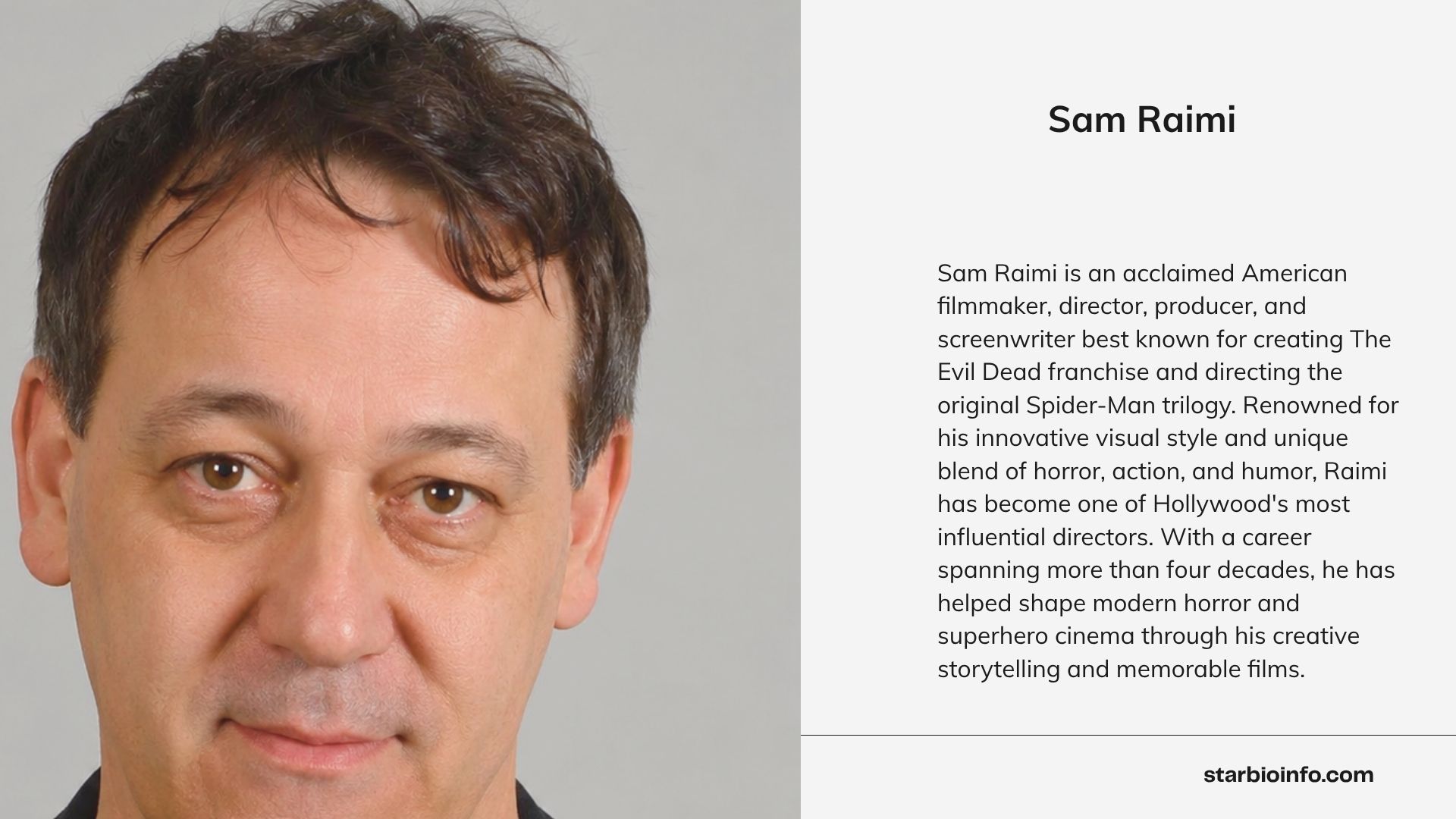
Introduction
Few filmmakers have left a mark on Hollywood as deeply as Sam Raimi. Known for his energetic directing style, innovative camera techniques, and unforgettable storytelling, Raimi has successfully transformed both horror and superhero cinema. From creating the cult-classic The Evil Dead on a shoestring budget to directing the groundbreaking Spider-Man trilogy, his career spans more than four decades of creativity and commercial success.
Unlike many directors who stay within one genre, Raimi has continuously experimented with horror, fantasy, action, comedy, thrillers, westerns, and superhero films. His ability to blend suspense with humor and emotional storytelling has earned him a loyal fan base worldwide.
Today, Sam Raimi is regarded as one of Hollywood’s most influential directors, inspiring countless filmmakers and proving that creativity matters more than budget.
Sam Raimi Biography
| Detail | Information |
|---|---|
| Full Name | Samuel Marshall Raimi |
| Popular Name | Sam Raimi |
| Date of Birth | October 23, 1959 |
| Age | 66 Years (2026) |
| Birthplace | Royal Oak, Michigan, United States |
| Nationality | American |
| Profession | Film Director, Producer, Screenwriter, Actor |
| Years Active | 1977–Present |
| Famous For | The Evil Dead, Spider-Man Trilogy |
| Production Company | Renaissance Pictures |
| Estimated Net Worth | $60–80 Million (Estimated) |
Who Is Sam Raimi?
Sam Raimi is an American filmmaker best known for revolutionizing horror movies and helping redefine modern superhero films. He first gained recognition through the low-budget horror masterpiece The Evil Dead, which became one of the most influential horror films ever made.
Years later, Raimi reached global superstardom after directing the original Spider-Man trilogy starring Tobey Maguire. Those films proved that superhero movies could combine emotional storytelling, spectacular action, and commercial success.
Beyond directing, Raimi is also an accomplished producer and writer who has worked on numerous successful television series and films.
Early Life and Childhood
Samuel Marshall Raimi was born on October 23, 1959, in Royal Oak, Michigan, USA, into a close-knit Jewish family. He grew up in nearby Birmingham, Michigan, where he spent much of his childhood imagining stories and experimenting with filmmaking.
His parents encouraged creativity, although filmmaking was not initially seen as a practical career choice.
Even as a young boy, Raimi loved watching adventure films, monster movies, slapstick comedy, and classic horror. These influences would later become defining elements of his directing style.
His fascination with cameras began during his teenage years when he started making homemade movies with friends using inexpensive equipment.
Friendship That Changed Everything
One of the most important relationships in Sam Raimi’s life began during high school when he met Bruce Campbell.
The two quickly became close friends because of their shared passion for filmmaking.
Together they produced dozens of amateur short films, experimenting with camera angles, special effects, comedy, and horror.
These early projects became the foundation for Raimi’s future filmmaking style.
Bruce Campbell would later become the star of The Evil Dead franchise and remain Raimi’s longtime creative collaborator.
Education
Sam Raimi attended Michigan State University, where he studied English.
However, college never became his primary focus.
Instead, he spent much of his time creating independent films and building practical filmmaking experience.
Eventually, Raimi left university to pursue filmmaking full-time, believing that real-world experience offered greater opportunities than classroom education.
His decision proved to be one of the most important turning points in his life.
The Beginning of His Career
Like many successful directors, Raimi started with almost no budget.
Instead of waiting for Hollywood opportunities, he created his own.
Together with Bruce Campbell, Robert Tapert, and several close friends, Raimi began producing independent projects that showcased his imagination despite limited financial resources.
These early films demonstrated remarkable creativity and helped attract investors willing to support his first feature film.
Creating The Evil Dead
In the late 1970s, Raimi directed a short horror film titled Within the Woods.
The short film successfully convinced investors to finance a full-length feature.
That feature became The Evil Dead, released in 1981.
Made for only around $350,000, the film followed a group of college friends trapped inside a remote cabin where supernatural forces begin possessing them one by one.
Although produced on an extremely limited budget, the movie impressed audiences with its originality, practical effects, terrifying atmosphere, and energetic camera work.
The film eventually became one of the most profitable independent horror movies ever made.
Why The Evil Dead Became a Horror Classic
Several factors helped the film achieve legendary status.
Innovative Camera Movement
Raimi developed the famous “shaky camera” technique that allowed audiences to experience scenes from the monster’s perspective.
This style became one of horror cinema’s most recognizable visual techniques.
Practical Effects
Instead of relying on expensive visual effects, Raimi used handmade props, makeup, fake blood, prosthetics, and clever editing.
Many horror fans still prefer these practical effects over modern CGI.
Perfect Blend of Horror and Comedy
Although genuinely frightening, the movie also included dark humor that made it unique compared to traditional horror films.
This balance became Raimi’s signature directing style.
Expanding the Evil Dead Universe
Following the success of the original film, Raimi directed:
- Evil Dead II (1987)
- Army of Darkness (1992)
Rather than simply creating sequels, Raimi expanded the story with larger action sequences, fantasy elements, and more comedy.
The franchise developed a massive international fan following and remains one of horror’s most beloved series.
Decades later, new films and television adaptations continued the franchise’s popularity, proving the lasting impact of Raimi’s original vision.
Hollywood Recognition
After establishing himself in horror, Raimi wanted to prove he could direct different types of films.
He accepted projects across multiple genres, including:
- Crime thrillers
- Westerns
- Sports dramas
- Romantic dramas
- Mystery thrillers
- Psychological horror
This willingness to experiment helped him avoid being labeled as only a horror director.
Hollywood studios increasingly recognized his ability to balance entertainment with strong visual storytelling.
Breaking Genre Boundaries
Throughout the 1990s, Raimi directed several critically appreciated films including:
Darkman (1990)
A unique superhero film starring Liam Neeson that combined comic-book action with horror-inspired visuals.
Many critics consider it one of the earliest modern superhero movies before the genre became mainstream.
The Quick and the Dead (1995)
A stylish western featuring Sharon Stone, Gene Hackman, Russell Crowe, and Leonardo DiCaprio.
Although its box office performance was modest, the film gained appreciation over time for its energetic direction.
A Simple Plan (1998)
This crime thriller earned widespread critical praise.
Unlike his earlier horror films, it showcased Raimi’s ability to create emotional tension through realistic storytelling.
Many critics considered it among the finest films of his career.
Spider-Man Changed Everything
By the early 2000s, comic-book movies were still considered risky investments.
Marvel wanted a director capable of combining emotional storytelling with spectacular action.
Sam Raimi became that director.
His lifelong love for comic books made him the ideal choice.
The result was one of the biggest turning points in Hollywood history.
Spider-Man (2002)
Released in 2002, Spider-Man became an instant global phenomenon.
Starring:
- Tobey Maguire
- Kirsten Dunst
- Willem Dafoe
- James Franco
The movie introduced audiences to a heartfelt version of Peter Parker while delivering groundbreaking visual effects and memorable action sequences.
It became one of the highest-grossing films of its time and proved that superhero movies could dominate worldwide box offices.
Spider-Man 2 (2004)
Many critics still consider Spider-Man 2 one of the greatest superhero films ever made.
The film perfectly balanced:
- Emotional storytelling
- Character development
- Humor
- Romance
- Spectacular action
Doctor Octopus became one of the genre’s most memorable villains, while Peter Parker’s personal struggles gave the movie remarkable emotional depth.
The famous train sequence remains one of superhero cinema’s greatest action scenes.
Spider-Man 3 (2007)
The third installment became one of the highest-grossing films of 2007.
Although opinions among critics were divided, audiences praised its ambitious scale, emotional moments, and impressive visual effects.
Despite its mixed reception, the trilogy as a whole fundamentally changed the superhero genre and paved the way for the success of future Marvel and DC films.
How Sam Raimi Revolutionized Superhero Movies
Before Raimi’s Spider-Man films, superhero movies often focused mainly on action.
Raimi introduced something different:
- Emotional storytelling
- Relatable characters
- Strong moral themes
- Human relationships
- Character-driven conflicts
- Visually dynamic action
- Comic-book authenticity
His approach influenced countless superhero films released over the following two decades.
Other Major Films
Even outside horror and superhero cinema, Raimi built an impressive filmography.
Some of his notable works include:
- For Love of the Game (1999) – A sports drama starring Kevin Costner that explored baseball alongside themes of love, aging, and personal reflection.
- The Gift (2000) – A supernatural thriller featuring Cate Blanchett, Keanu Reeves, Giovanni Ribisi, Katie Holmes, and Hilary Swank. The film blended mystery with psychological suspense.
- Drag Me to Hell (2009) – A return to Raimi’s horror roots, praised for its mix of terrifying supernatural elements and dark comedy. It became a favorite among horror fans and critics alike.
- Oz the Great and Powerful (2013) – A fantasy adventure inspired by the world of The Wizard of Oz. The visually ambitious film showcased Raimi’s ability to handle large-scale family entertainment.
Television Career
Although Sam Raimi is best known for directing feature films, his influence extends well beyond the big screen. Over the years, he has produced and developed several successful television series, particularly in the horror and fantasy genres.
One of his most celebrated television projects is Ash vs Evil Dead (2015–2018), which continued the story of Ash Williams decades after the original Evil Dead films. Starring longtime collaborator Bruce Campbell, the series combined over-the-top horror, comedy, and action while introducing the franchise to a new generation of viewers.
Raimi also served as an executive producer on numerous television projects, helping shape creative direction and supporting new filmmakers. His involvement often ensured that projects maintained strong storytelling, memorable characters, and the distinctive visual energy that audiences associate with his work.
Renaissance Pictures
In the late 1970s, Sam Raimi co-founded Renaissance Pictures with Bruce Campbell and Robert Tapert. What began as a small independent production company eventually became one of Hollywood’s respected creative studios.
The company has been involved in producing:
- Feature films
- Television series
- Horror franchises
- Fantasy adventures
- Independent productions
Renaissance Pictures played a key role in keeping the Evil Dead franchise alive while allowing Raimi to support unique projects outside mainstream studio filmmaking.
Producing Career
While directing remains his greatest passion, Raimi has also built an impressive reputation as a producer.
Some notable productions include:
- Don’t Breathe
- Don’t Breathe 2
- Crawl
- 30 Days of Night
- The Grudge
- Evil Dead (2013)
- Poltergeist (2015)
As a producer, Raimi often supports horror filmmakers by providing creative guidance rather than dominating the filmmaking process. Many directors have credited him with encouraging original ideas instead of forcing commercial formulas.
Return to the Marvel Universe
After completing the Spider-Man trilogy, Raimi spent several years directing films in different genres before returning to superhero cinema.
In 2022, he directed Doctor Strange in the Multiverse of Madness, one of Marvel Studios’ most ambitious films.
The movie combined:
- Superhero action
- Horror elements
- Fantasy
- Multiverse storytelling
- Psychological suspense
Fans immediately recognized Raimi’s signature style, especially in the horror-inspired sequences and dynamic camera movements. His return demonstrated that even after decades in Hollywood, he remained one of the industry’s most creative directors.
Sam Raimi’s Directing Style
Few filmmakers have a visual identity as recognizable as Sam Raimi. His films are known for their energy, creativity, and willingness to experiment with the camera.
Fast Camera Movements
Raimi frequently uses rapid tracking shots and sweeping camera movements to place viewers directly into the action. These techniques create urgency and excitement while making supernatural scenes feel more immersive.
Practical Effects
Even in the era of computer-generated imagery, Raimi continues to value practical makeup, prosthetics, and physical effects. This approach gives many of his films a tangible, handcrafted feel that audiences appreciate.
Horror Mixed with Humor
One of Raimi’s trademarks is blending frightening moments with unexpected comedy. Instead of reducing tension, the humor often makes the horror even more memorable by catching viewers off guard.
Dynamic Action
Whether directing a horror film or a superhero blockbuster, Raimi emphasizes movement and rhythm. His action sequences are fast-paced, visually inventive, and carefully choreographed.
Emotional Storytelling
Behind the spectacle, Raimi focuses on relatable characters. Themes such as responsibility, sacrifice, family, friendship, and redemption appear throughout his filmography, giving his stories lasting emotional impact.
Influence on Modern Cinema
Sam Raimi’s influence can be seen across multiple genres.
His innovations helped shape:
- Independent horror filmmaking
- Modern superhero movies
- Creative camera techniques
- Practical visual effects
- Character-driven blockbuster storytelling
Many younger directors cite Raimi as an inspiration because he proved that imagination and strong storytelling can overcome limited budgets.
His Spider-Man trilogy also demonstrated that comic book movies could combine emotional depth with blockbuster entertainment, paving the way for the superhero boom that followed.
Awards and Achievements
Throughout his career, Sam Raimi has received recognition from critics, film organizations, and industry peers.
Some of his major accomplishments include:
- Saturn Award nominations for directing and producing
- Academy of Science Fiction, Fantasy & Horror Films honors
- Critics’ recognition for A Simple Plan
- International awards for The Evil Dead
- Recognition for his contributions to horror cinema
- Multiple lifetime achievement honors from film festivals and genre organizations
Beyond formal awards, Raimi’s greatest achievement is the lasting popularity of his films, many of which continue to attract new audiences decades after their release.
Complete Filmography (Selected)
As Director
- The Evil Dead (1981)
- Crimewave (1985)
- Evil Dead II (1987)
- Darkman (1990)
- Army of Darkness (1992)
- The Quick and the Dead (1995)
- A Simple Plan (1998)
- For Love of the Game (1999)
- The Gift (2000)
- Spider-Man (2002)
- Spider-Man 2 (2004)
- Spider-Man 3 (2007)
- Drag Me to Hell (2009)
- Oz the Great and Powerful (2013)
- Doctor Strange in the Multiverse of Madness (2022)
Personal Life
Despite his Hollywood success, Sam Raimi has maintained a relatively private personal life. He is known for focusing on his family and long-term creative partnerships rather than seeking constant public attention.
Friends and colleagues often describe him as approachable, collaborative, and deeply passionate about filmmaking.
Wife and Children
Sam Raimi is married to Gillian Greene, daughter of actor Lorne Greene. The couple has been together for many years and has five children.
Although Raimi occasionally appears at film premieres and industry events with his family, he generally keeps his personal life away from the spotlight. This privacy has allowed him to maintain a stable balance between his career and family life.
Sam Raimi Net Worth
As of 2026, Sam Raimi’s estimated net worth is between $60 million and $80 million. Since he is privately involved in multiple production and investment ventures, the exact figure has not been publicly confirmed.
His wealth has grown steadily over more than four decades thanks to blockbuster films, producing credits, television projects, and long-term royalty income.
Income Sources
Sam Raimi earns money from several streams, including:
- Film directing fees
- Film production
- Screenwriting
- Executive producer credits
- Television production
- Box office profit participation
- Streaming and television royalties
- Licensing and franchise revenue
- Speaking appearances and industry events
The continued popularity of franchises like Spider-Man and Evil Dead also contributes to his long-term earnings.
Interesting Facts About Sam Raimi
- He began making movies as a teenager using homemade equipment.
- Bruce Campbell has appeared in many of his projects and remains one of his closest collaborators.
- Raimi is a lifelong comic book enthusiast.
- He enjoys experimenting with new filmmaking techniques and camera technology.
- Many directors credit The Evil Dead as an inspiration for pursuing careers in horror filmmaking.
- His Spider-Man trilogy helped establish the modern superhero blockbuster formula.
- He often includes subtle references, recurring visual motifs, and playful cameos across his films.
Legacy
Sam Raimi’s influence reaches far beyond the movies he has directed. His willingness to take creative risks, embrace practical filmmaking, and blend genres has inspired countless filmmakers around the world.
From independent horror classics to billion-dollar superhero franchises, Raimi has shown that compelling stories and memorable characters can resonate with audiences of every generation.
His work continues to shape modern cinema, making him one of Hollywood’s most respected and enduring filmmakers.
Future Projects
Fans continue to speculate about Raimi’s future, particularly regarding possible horror films, superhero projects, and new original stories. While not every rumored project becomes reality, his name is frequently associated with major studio productions because of his proven ability to balance artistic creativity with commercial success.
Given his track record, any new Sam Raimi project is likely to attract significant attention from both critics and moviegoers.
Frequently Asked Questions (FAQs)
Who is Sam Raimi?
Sam Raimi is an American film director, producer, screenwriter, and actor best known for The Evil Dead franchise and the original Spider-Man trilogy.
When was Sam Raimi born?
He was born on October 23, 1959, in Royal Oak, Michigan, United States.
What is Sam Raimi famous for?
He is famous for directing The Evil Dead films, the Spider-Man trilogy, and Doctor Strange in the Multiverse of Madness.
Who is Sam Raimi’s wife?
Sam Raimi is married to Gillian Greene.
How many children does Sam Raimi have?
He has five children.
What is Sam Raimi’s estimated net worth?
His estimated net worth in 2026 is between $60 million and $80 million, based on public estimates.
Which Spider-Man movies did Sam Raimi direct?
He directed:
- Spider-Man (2002)
- Spider-Man 2 (2004)
- Spider-Man 3 (2007)
What was Sam Raimi’s first major film?
His breakthrough feature was The Evil Dead (1981), which became a landmark in independent horror cinema.
Final Thoughts
Sam Raimi’s journey from making low-budget films with friends in Michigan to becoming one of Hollywood’s most influential directors is a testament to creativity, determination, and passion. His groundbreaking work in horror, unforgettable contributions to superhero cinema, and enduring influence on filmmakers worldwide have secured his place among the industry’s great storytellers.
Whether revisiting the terrifying world of The Evil Dead, experiencing the emotional heroism of the Spider-Man trilogy, or exploring the multiverse through Doctor Strange, audiences continue to appreciate Raimi’s unique ability to combine imagination, emotion, humor, and visual innovation. His legacy will remain an important part of film history for generations to come.
- Who Is Chris Hemsworth’s Wife? Inside His Marriage to Elsa Pataky
- How Shay Hatten Became One of Hollywood’s Most In-Demand Action Screenwriters
- How Zach Cregger Reinvented Himself from Comedian to Acclaimed Horror Filmmaker
- How Kali Reis Transitioned from Boxing Champion to Hollywood Star
- How Paul Walter Hauser Became One of Hollywood’s Most Respected Character Actors