
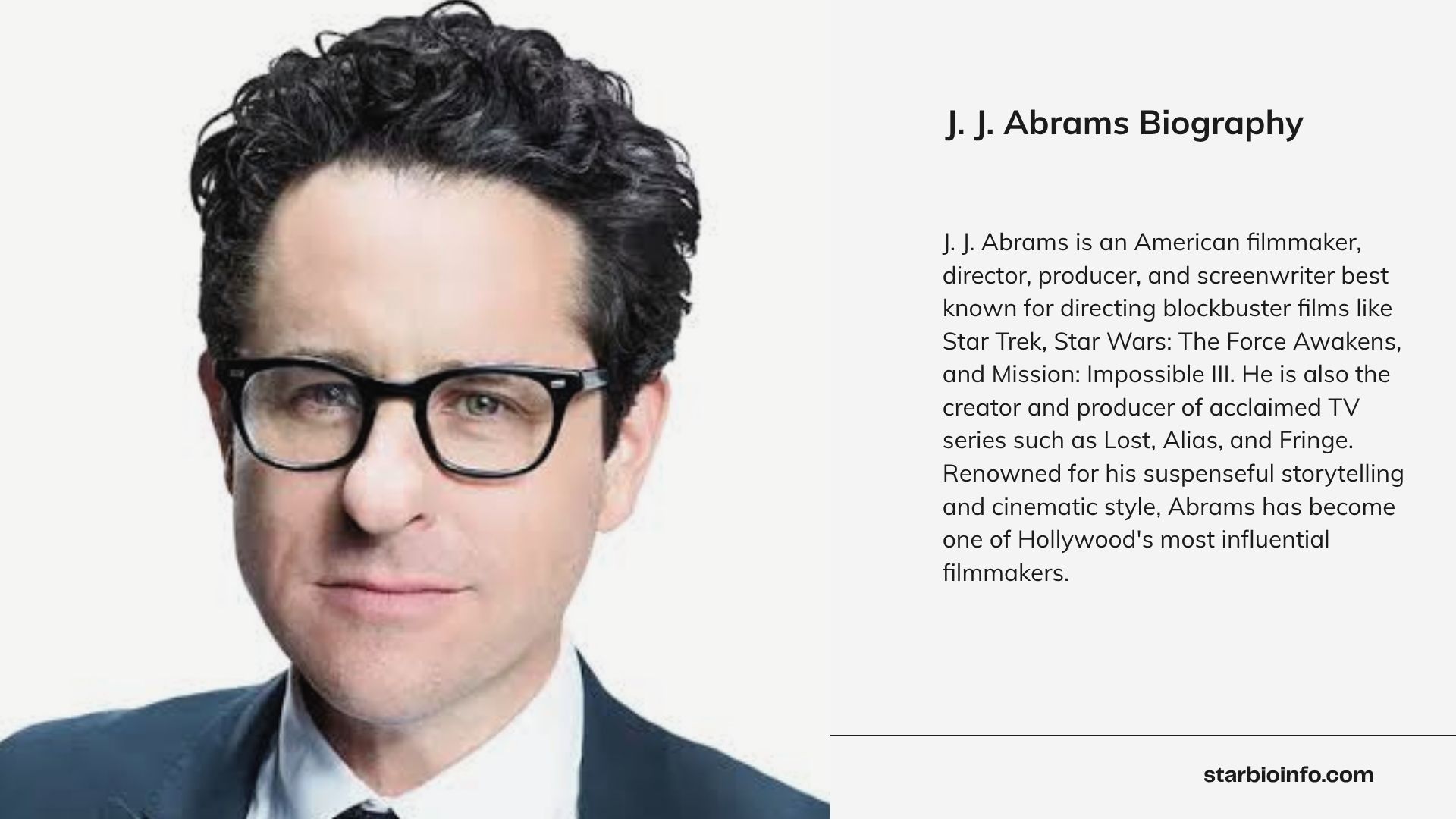
Introduction
J. J. Abrams is one of Hollywood’s most influential filmmakers, known for creating suspenseful stories, memorable characters, and visually spectacular blockbusters. As a director, producer, screenwriter, and television creator, he has shaped modern entertainment with some of the biggest franchises in film history, including Star Trek, Star Wars, and Mission: Impossible. Beyond films, Abrams also transformed television through critically acclaimed series such as Lost, Alias, Fringe, and Felicity.
His unique storytelling style combines mystery, emotional depth, science fiction, and action, making his work appealing to audiences around the world. Over the years, he has earned a reputation as a filmmaker who can successfully revive legendary franchises while also creating original stories that capture viewers’ imagination.
This biography explores J. J. Abrams’ early life, education, career journey, filmmaking style, famous movies, television success, personal life, and lasting impact on Hollywood.
Early Life and Childhood
Jeffrey Jacob Abrams, popularly known as J. J. Abrams, was born on June 27, 1966, in New York City, United States. He grew up in a creative family that encouraged artistic expression from a young age.
His father, Gerald W. Abrams, worked as a television producer, while his mother, Carol Ann Abrams, was involved in television production as an executive producer. Growing up in such an environment exposed Abrams to filmmaking, storytelling, and television production long before he entered the entertainment industry professionally.
When Abrams was still young, his family relocated to Los Angeles, California, where he spent most of his childhood. Living near Hollywood gave him the opportunity to explore filmmaking equipment, movie studios, and cinema culture, all of which fueled his passion for directing.
As a child, Abrams loved making short movies with his friends using Super 8 cameras. Instead of simply watching films, he became fascinated by how they were made. He experimented with editing, practical effects, and storytelling techniques that would later become hallmarks of his professional career.
Education
Abrams attended Palisades Charter High School in Los Angeles before enrolling at Sarah Lawrence College in New York.
Unlike many future directors, Abrams was already attracting professional attention while still in college. His writing skills impressed industry professionals, allowing him to begin working on film scripts at a relatively young age.
Rather than following a traditional path into filmmaking, Abrams built his reputation through screenwriting before eventually moving into directing and producing.
Early Career in Hollywood
J. J. Abrams entered Hollywood as a screenwriter during the late 1980s and early 1990s.
Some of his earliest writing credits include films such as:
- Regarding Henry (1991)
- Forever Young (1992)
These projects introduced Abrams to major Hollywood productions and helped establish him as a talented writer capable of balancing emotional storytelling with commercial appeal.
Although these early films were successful, Abrams wanted greater creative control over his projects. This ambition eventually led him toward television production and later film directing.
Success in Television
Before becoming one of Hollywood’s biggest directors, Abrams revolutionized television.
Felicity (1998)
His first major television success came with Felicity, a coming-of-age drama that earned praise for its emotional storytelling and relatable characters.
The show’s popularity proved Abrams could create long-form stories that kept viewers emotionally invested.
Alias (2001)
Abrams reached another level of success with Alias, starring Jennifer Garner.
The series combined:
- Spy action
- Mystery
- Family drama
- International conspiracies
Its cinematic production values helped redefine television storytelling during the early 2000s.
Lost (2004)
One of Abrams’ most influential achievements was co-creating Lost.
The series followed survivors of a mysterious plane crash stranded on an island filled with unexplained phenomena.
Lost became a worldwide cultural phenomenon because of its:
- Complex mysteries
- Character-driven storytelling
- Unexpected twists
- Emotional flashbacks
- Innovative narrative structure
The show’s influence continues to inspire television creators around the world.
Fringe (2008)
Abrams later co-created Fringe, a science-fiction drama exploring parallel universes, advanced technology, and unexplained scientific events.
The series developed a loyal fan base and remains one of the most respected science-fiction television shows of the 21st century.
Transition to Film Directing
Although Abrams had already built an impressive television career, he always dreamed of directing major Hollywood films.
His opportunity arrived with Mission: Impossible III (2006).
Despite being his first feature film as a director, Abrams successfully handled the enormous responsibility of continuing one of Hollywood’s biggest action franchises.
The film showcased many qualities that would define his directing style:
- Fast-paced storytelling
- Strong emotional character arcs
- Spectacular action sequences
- Clever suspense
- High production values
Its success established Abrams as one of Hollywood’s most promising blockbuster directors.
Reinventing Star Trek
In 2009, Abrams directed Star Trek, introducing a fresh generation of audiences to the legendary science-fiction franchise.
Instead of simply continuing earlier stories, Abrams created an alternate timeline that allowed new actors to portray iconic characters while respecting the original series.
The film was praised for its:
- Modern visual effects
- Emotional storytelling
- Humor
- Action
- Strong performances
It became both a commercial and critical success.
He later returned to direct Star Trek Into Darkness (2013), which expanded the rebooted universe with larger action sequences and deeper character conflicts.
Both films demonstrated Abrams’ ability to modernize beloved franchises without losing their original spirit.
A Signature Filmmaking Style
Over the years, J. J. Abrams has developed a distinctive directing style that audiences instantly recognize.
His films often feature:
- Mystery-driven storytelling
- Emotional character relationships
- Large-scale visual spectacle
- Practical effects combined with CGI
- Fast pacing
- Unexpected twists
- Memorable musical scores
- Strong ensemble casts
Another defining element is his famous “Mystery Box” storytelling philosophy. Abrams believes audiences stay emotionally invested when stories leave intriguing questions unanswered until the right moment.
This approach has become one of the defining characteristics of his work across both film and television.
Directing Super 8
Following the success of Star Trek, J. J. Abrams directed Super 8 (2011), an original science-fiction adventure produced by Steven Spielberg. The film tells the story of a group of teenagers who witness a mysterious train crash while making a homemade movie.
Super 8 was praised for its nostalgic atmosphere, emotional storytelling, and suspense. It demonstrated that Abrams could create compelling original stories in addition to revitalizing established franchises.
Joining the Star Wars Universe
In 2015, J. J. Abrams took on one of the biggest challenges of his career when he directed Star Wars: The Force Awakens. As the first installment of the sequel trilogy, the film carried enormous expectations from fans worldwide.
The movie introduced new characters such as Rey, Finn, Poe Dameron, and Kylo Ren while bringing back iconic heroes like Han Solo, Leia Organa, and Luke Skywalker. It became a massive commercial success and grossed over $2 billion worldwide, making it one of the highest-grossing films in history.
Abrams returned to direct Star Wars: The Rise of Skywalker (2019), concluding the Skywalker Saga that had begun more than four decades earlier. Although the film received mixed reviews from critics, it performed strongly at the global box office and marked the end of one of cinema’s most famous storylines.
Bad Robot Productions
J. J. Abrams is the founder of Bad Robot Productions, a production company established in 2001. The company has become one of Hollywood’s leading creative studios, producing feature films, television series, documentaries, and streaming content.
Bad Robot has been involved in projects across multiple genres, including science fiction, action, thriller, fantasy, horror, and drama. The company’s recognizable logo has become familiar to audiences around the world.
Some well-known productions from Bad Robot include:
- Lost
- Alias
- Fringe
- Westworld (producer)
- Lovecraft Country (producer)
- Cloverfield
- 10 Cloverfield Lane
- Overlord
- Mission: Impossible films (producer)
- Various Star Trek and Star Wars projects
Producing Career
In addition to directing, Abrams has become one of Hollywood’s busiest producers. Through Bad Robot Productions, he has supported both blockbuster franchises and smaller original projects.
His producing work spans films, streaming platforms, and television, helping launch new filmmakers while continuing to develop major entertainment franchises.
His ability to balance commercial success with creative storytelling has made him one of the industry’s most respected producers.
Personal Life
J. J. Abrams is married to Katie McGrath, a public relations executive. The couple married in 1996 and have built a stable family life despite Abrams’ demanding career in Hollywood.
Together, they have three children. Abrams generally keeps his personal life private and prefers to let his work speak for itself. Unlike many celebrities, he rarely discusses family matters publicly.
Outside filmmaking, Abrams is passionate about storytelling, photography, music, technology, and vintage filmmaking equipment. He is also known for his lifelong fascination with magic tricks, mystery, and classic science-fiction films.
Awards and Recognition
Over the course of his career, Abrams has received numerous honors and nominations for both television and film.
His achievements include:
- Primetime Emmy Award recognition for television work.
- Producers Guild honors.
- Saturn Award nominations and wins.
- Hugo Award recognition for science-fiction storytelling.
- Multiple critics’ awards for directing and producing.
- Worldwide recognition for revitalizing iconic franchises.
Beyond awards, Abrams is respected for influencing a new generation of filmmakers and television creators.
Complete Filmography (Director)
Films
- Mission: Impossible III (2006)
- Star Trek (2009)
- Super 8 (2011)
- Star Trek Into Darkness (2013)
- Star Wars: The Force Awakens (2015)
- Star Wars: The Rise of Skywalker (2019)
Selected Television Projects
- Felicity
- Alias
- Lost
- Fringe
- Person of Interest (producer)
- Westworld (producer)
- Lovecraft Country (producer)
Directing Style
J. J. Abrams has developed a distinctive filmmaking style that blends emotional storytelling with large-scale entertainment. His work often combines:
- Strong character relationships.
- Fast-paced narratives.
- Mystery-driven plots.
- Science-fiction concepts.
- Practical effects enhanced with CGI.
- Cinematic visuals.
- Dynamic action sequences.
- Memorable musical collaborations.
One of his most discussed storytelling concepts is the “Mystery Box” philosophy, which focuses on creating curiosity and gradually revealing information to keep audiences engaged throughout the story.
Net Worth
As of 2026, J. J. Abrams’ estimated net worth is approximately $300 million.
His wealth comes from multiple income sources, including:
- Film directing
- Television production
- Screenwriting
- Producing blockbuster franchises
- Bad Robot Productions
- Long-term studio and streaming partnerships
- Royalties and licensing agreements
His business ventures and production company continue to contribute significantly to his financial success.
Interesting Facts About J. J. Abrams
- His full name is Jeffrey Jacob Abrams.
- He began making short films as a child using Super 8 cameras.
- Steven Spielberg has been one of his longtime inspirations.
- He is famous for using lens flares in many of his films.
- Abrams successfully rebooted both the Star Trek and Star Wars franchises.
- He founded Bad Robot Productions in 2001.
- He has worked as a writer, director, producer, and composer.
- His storytelling techniques have influenced many modern filmmakers.
Legacy
J. J. Abrams has become one of the defining filmmakers of the 21st century. His ability to modernize classic franchises while introducing fresh characters has earned him worldwide recognition. Whether through groundbreaking television series like Lost or blockbuster films such as Star Wars: The Force Awakens, Abrams has consistently delivered stories that entertain global audiences.
His work has inspired countless directors, writers, and producers, ensuring that his influence on modern cinema and television will continue for years to come.
Frequently Asked Questions (FAQs)
Who is J. J. Abrams?
J. J. Abrams is an American film director, producer, screenwriter, and television creator known for directing Star Trek, Star Wars: The Force Awakens, Super 8, and Mission: Impossible III.
What is J. J. Abrams’ real name?
His full name is Jeffrey Jacob Abrams.
How old is J. J. Abrams?
Born on June 27, 1966, J. J. Abrams is 60 years old in 2026.
What is J. J. Abrams famous for?
He is famous for directing blockbuster films, creating hit television series, and reviving major franchises such as Star Trek and Star Wars.
Is J. J. Abrams married?
Yes. He has been married to Katie McGrath since 1996.
How many children does J. J. Abrams have?
He and his wife have three children.
What is J. J. Abrams’ net worth?
His estimated net worth in 2026 is around $300 million.
- Who Is Chris Hemsworth’s Wife? Inside His Marriage to Elsa Pataky
- How Shay Hatten Became One of Hollywood’s Most In-Demand Action Screenwriters
- How Zach Cregger Reinvented Himself from Comedian to Acclaimed Horror Filmmaker
- How Kali Reis Transitioned from Boxing Champion to Hollywood Star
- How Paul Walter Hauser Became One of Hollywood’s Most Respected Character Actors